
Why Holiday Parks Are Leading the Way in Safe Public WiFi for Families

Holiday parks have long been places where families come together to relax, explore and spend quality time away from everyday life. Across the UK and Europe, many parks welcome thousands of families each week, with guests spending extended periods of time on site across accommodation, restaurants, leisure facilities and public spaces.
In recent years, public WiFi has become an important part of that visitor experience.
Whether guests are checking activity bookings, sharing holiday photos, keeping in touch with family or simply entertaining children between activities, reliable connectivity is now expected across many areas of a holiday park.
But as connectivity becomes more common, an increasingly important question arises for operators:
How do we demonstrate that the WiFi environment provided for families is safe and appropriate for all guests?
Public WiFi in Shared Family Environments
Holiday parks are unique environments. Unlike many public venues where visitors stay for a short time, guests at holiday parks often spend several days living within the park environment.
WiFi is typically available across:
accommodation lodges and cabins
restaurants and cafés
leisure facilities
activity centres
public village areas
In these shared environments, families, children and young people are often using devices side-by-side in public spaces.
While many operators already implement filtering within their network infrastructure, these protections are often invisible to the people using the network.
From a parent’s perspective, there is usually no obvious way to know whether a public WiFi network has been designed with family environments in mind.
Turning Invisible Protection into Visible Reassurance
This is where the Friendly WiFi Approved Standard plays an important role.
The standard independently verifies that public WiFi networks are filtered to recognised safety standards, helping ensure that inappropriate or indecent material cannot be accessed through the network.
But perhaps just as importantly, organisations that meet the standard are able to display the recognised Friendly WiFi symbol of approval.
That symbol provides something very powerful for visitors:
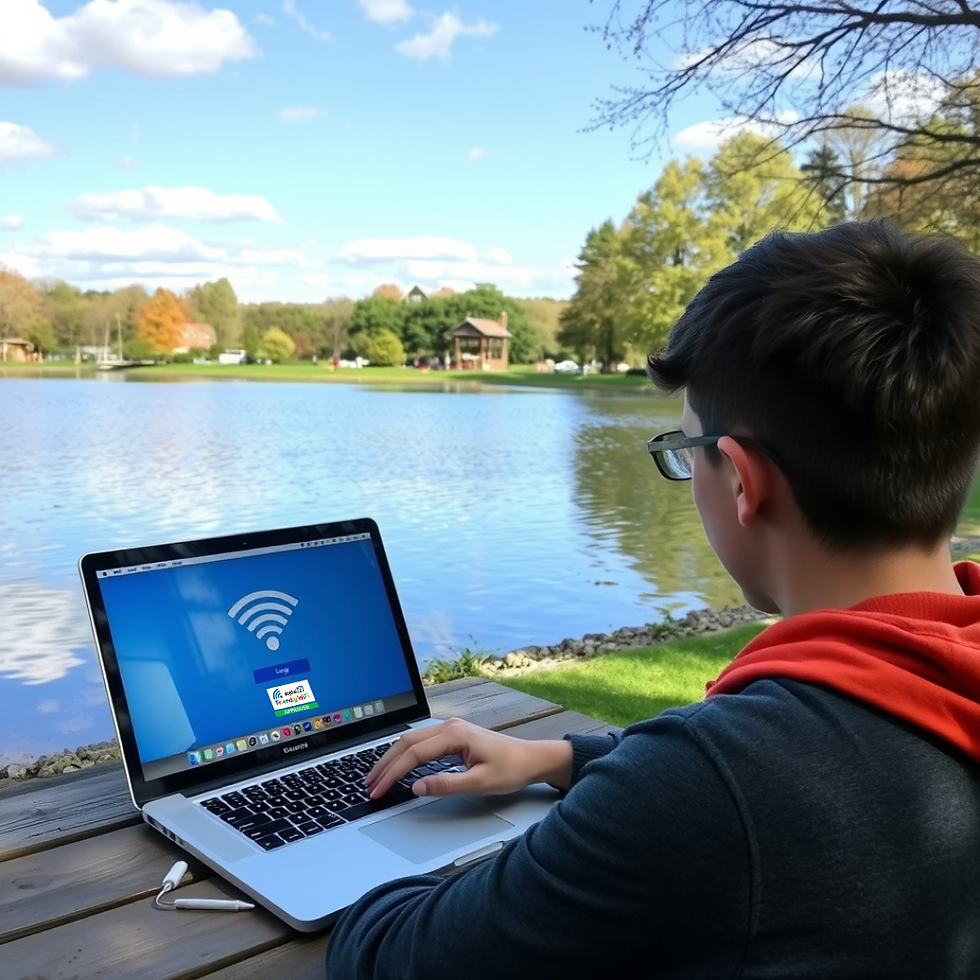
Visible Reassurance.
While filtering itself is invisible, the Friendly WiFi symbol allows organisations to clearly demonstrate that their public WiFi environment has been independently assessed and meets recognised safety standards.
In simple terms, it helps organisations turn invisible protection into visible reassurance.
Why This Matters for Holiday Parks
Holiday parks are environments built around family trust.
Parents expect that the spaces where their children play, eat and relax are designed with safety in mind — and increasingly that expectation extends into the digital environment.
Attempts to access inappropriate material on public networks occur constantly across the internet. Responsible organisations simply want to ensure that this type of content cannot appear within environments designed for families.
By implementing recognised filtering standards and displaying the Friendly WiFi symbol, holiday parks can demonstrate that the same level of care applied to physical safety also applies to their digital environments.
A Standard Already Used Across Major Leisure Venues
Across the UK, many organisations responsible for public venues — including transport hubs, retail destinations, leisure venues and holiday parks — already work with the Friendly WiFi standard.
In many cases, the appropriate filtering measures are already in place within existing networks.
The approval process simply provides independent verification that those protections are working as intended, alongside the ability to display a recognised symbol of approval for visitors.
Providing Confidence for Families
For parents planning holidays, reassurance matters.
Seeing a clear symbol that indicates a public WiFi environment has been independently assessed can provide an additional level of confidence that the venue has considered the safety of its digital environment as carefully as its physical one.
As connectivity continues to play a bigger role in how families experience holidays, many operators are recognising the importance of ensuring that their public WiFi environments are both safe and visibly responsible.
Because ultimately, safe digital environments are simply another part of creating places where families feel comfortable, relaxed and confident.


Comments